
ADVERTISEMENT
Politics
Algeria Prepares for Key Legislative Elections Amidst Political Reforms
Algeria is set to hold legislative elections on July 2, viewed as a crucial moment for political engagement and reform following the Hirak protest movement.
Jul 2, 2026, 1:56 AM | 1-2 min read | By Wadi News Editorial Team
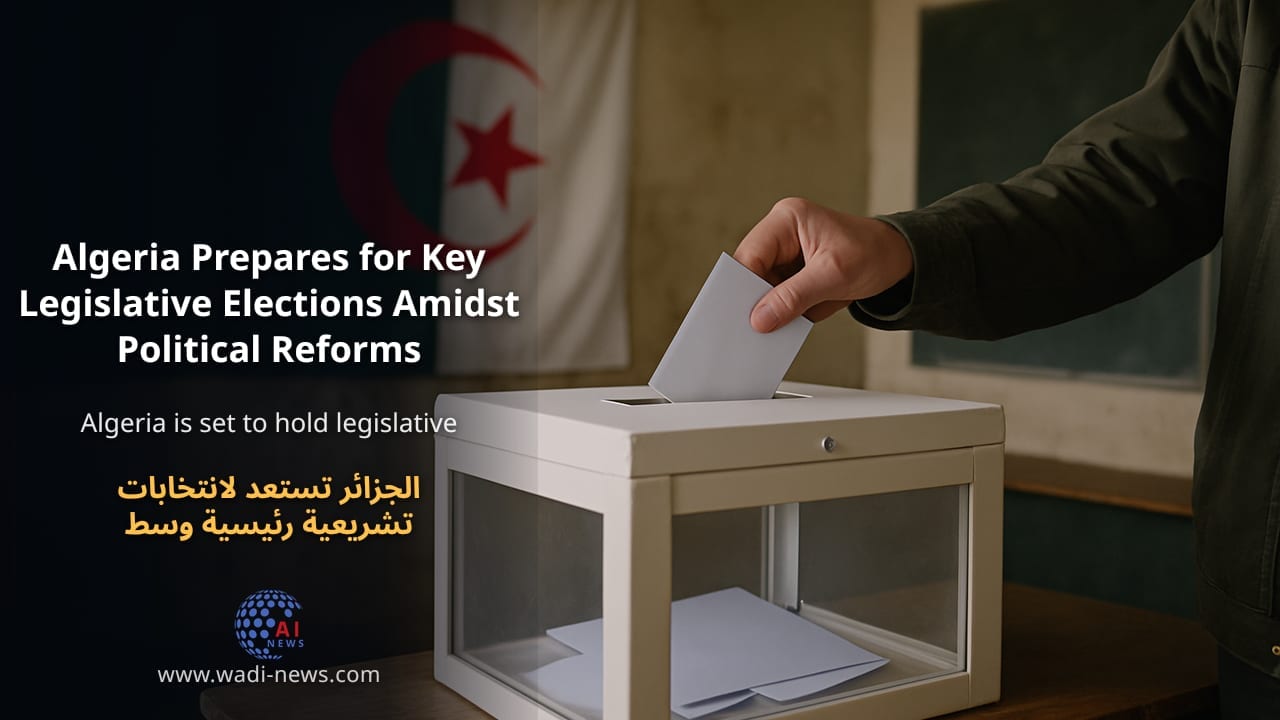
On July 2, Algeria will conduct legislative elections to fill the 407 seats of the People's National Assembly. This election is perceived as a significant test of public participation and political transformation, occurring over seven years after the Hirak protest movement that challenged the political status quo. The Independent National Authority of Elections (ANIE) reports that more than 24.7 million registered voters, including approximately 854,000 living abroad, are eligible to cast their votes in this pivotal election.
However, there are concerns regarding the anticipated low voter turnout, as established political powers continue to dominate the landscape. Many observers question whether the reforms initiated after the mass protests that led to the ousting of former President Abdelaziz Bouteflika have brought about substantial changes to Algeria's political framework. President Abdelmadjid Tebboune has framed the upcoming vote as part of his vision for a “new Algeria” following the 2019 uprising. Nonetheless, critics argue that executive power remains overwhelmingly strong, with parliament's role limited and opposition activities stifled by legal and political pressures.
Electoral authorities have faced scrutiny over the nomination process, as numerous candidates and party lists were rejected based on eligibility criteria and compliance with legal standards. Opposition figures and human rights advocates have raised alarms about increasingly stringent electoral laws that bolster state control over political competition. Activists associated with the Hirak movement, such as prominent opposition leader Karim Tabbou, have experienced legal challenges and restrictions since 2019, highlighting the shrinking space for political dissent.
Despite the government's assertions that reforms have enhanced institutional integrity and stability, skepticism remains. The electoral framework allows for an open-list proportional representation system, enabling voters to select party lists and express preferences for individual candidates. Established parties like the National Liberation Front (FLN) and the National Democratic Rally (RND) will face off against opposition groups, including the Movement of Society for Peace (MSP) and various independent lists. The FLN previously held 105 of the 407 parliamentary seats, and the 2021 election saw an alarmingly low turnout of just 23 percent, indicating widespread voter apathy. Economic issues are expected to dominate the campaigns, with candidates addressing concerns related to employment, inflation, and housing, as Algeria grapples with the challenges posed by its reliance on hydrocarbon revenues.