
ADVERTISEMENT
Politics
Supreme Court Ruling Broadens Presidential Authority
The US Supreme Court has issued a ruling that significantly enhances the powers of the presidency, allowing greater control over independent federal agencies, while maintaining the independence of the Federal Reserve.
Jun 30, 2026, 6:56 PM | 1-2 min read | By Wadi News Editorial Team
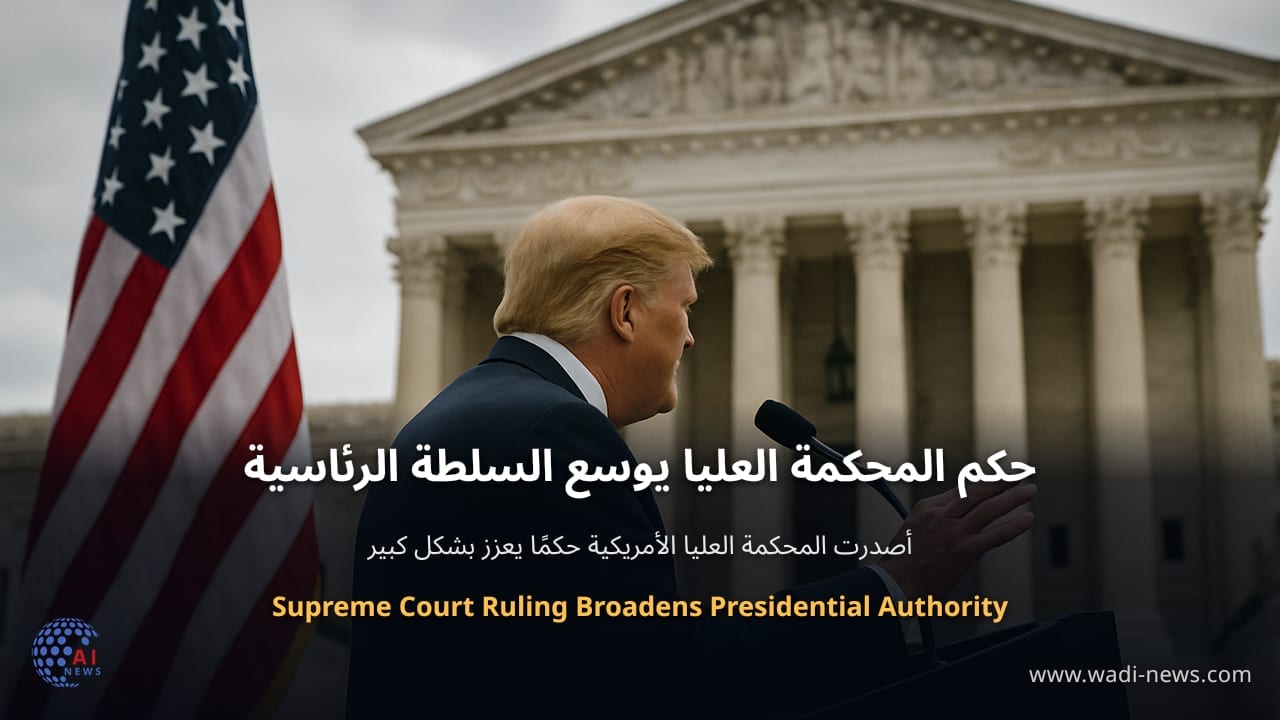
In a landmark decision on June 29, 2026, the US Supreme Court made a significant ruling that alters the landscape of presidential powers. The court overturned a precedent established in 1935 that had previously restricted the authority of presidents to dismiss heads of independent agencies. This ruling allows Presidents, including Donald Trump, to exercise much greater control over these agencies, which could reshape the dynamics of executive power in the United States.
The court's decision was not without limitations, however. While it upheld Trump's right to remove certain agency heads, it specifically ruled against his attempt to dismiss Lisa Cook, a governor of the Federal Reserve. This aspect of the ruling underscores the court's recognition of the need to preserve the independence of the Federal Reserve, which plays a critical role in the US economy. Chief Justice John Roberts emphasized that Fed governors serve staggered 14-year terms and can only be removed for cause, thus maintaining a check against arbitrary presidential actions.
The implications of this ruling are profound, as it reflects a shift in the balance of power between the presidency and independent regulatory agencies. Trump's administration had previously sought to exert influence over the Federal Reserve, particularly regarding interest rate policies. The court's decision thus not only affirms the independence of the Fed but also delineates the boundaries of presidential authority over federal agencies, a topic of heated debate in American politics.
In a separate ruling, the court also backed Trump's dismissal of Rebecca Slaughter from the Federal Trade Commission, further expanding the scope of presidential power. Trump celebrated this aspect of the ruling as a victory for presidential authority, stating that it confirms the right of a president to manage executive branch appointments. This duality in the court's decisions illustrates the complex nature of governance, where increased presidential powers can coexist with protections for specific independent bodies. As the political landscape evolves, the ramifications of these rulings will likely continue to influence discussions about executive power and the role of independent agencies in American democracy.