
ADVERTISEMENT
Politics
Al Jazeera Camera Exposes the Israeli Narrative: Frun is Free Lebanese Land and Was Not Occupied
The town of Frun in southern Lebanon reveals a contradiction between the Israeli narrative and the ground reality, confirming that Israeli forces did not enter it or establish positions there, despite suffering devastating bombardment.
Jun 30, 2026, 3:47 AM | 1-2 min read | By Wadi News Editorial Team
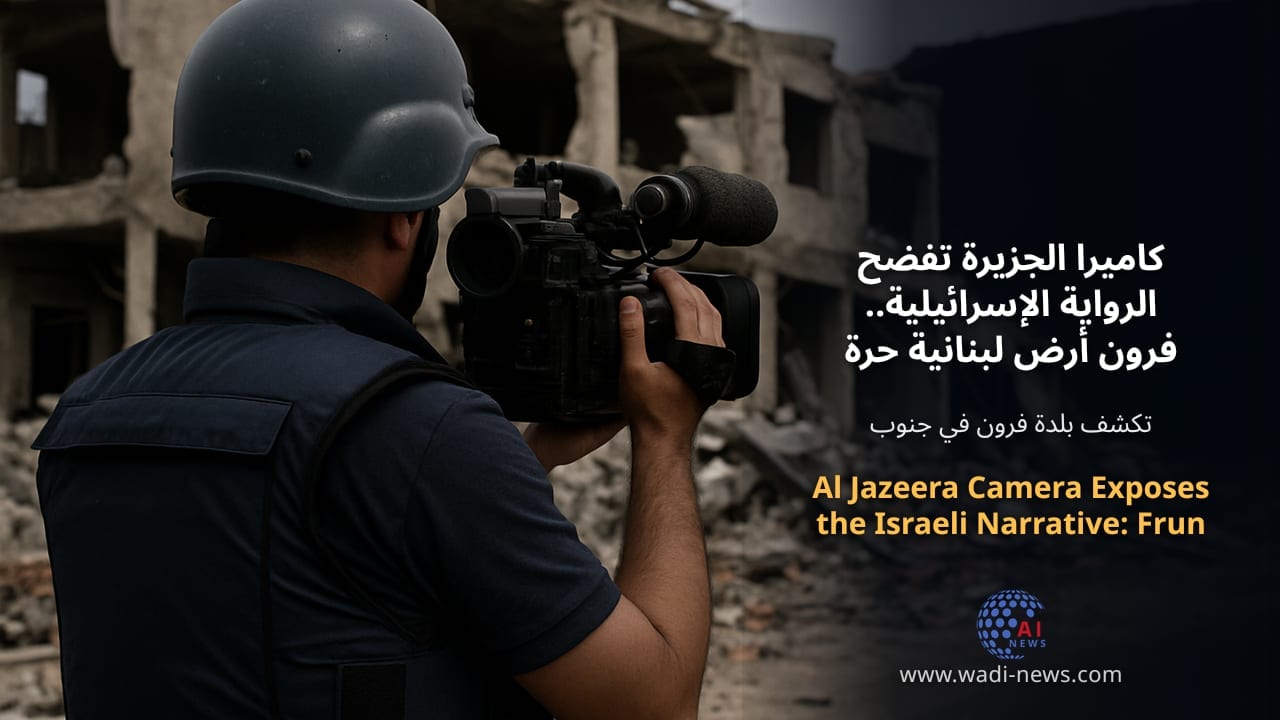
The town of Frun in southern Lebanon stands out amidst the border villages, presenting a unique situation. While Israel claims it is among the areas from which it is supposed to withdraw, the ground reality shows that Israeli forces never entered the town during the war, nor did they establish military positions or raise their flags there. Instead, Frun has paid a heavy price due to bombardments and airstrikes. According to Al Jazeera's correspondent in southern Lebanon, Mazen Ibrahim, Frun remained distinct from several border towns that experienced a direct presence of Israeli forces. Israeli tanks did not set foot on its land, while the Lebanese army has always been present, maintaining a center on the outskirts of the town near the Litani River, conducting regular patrols.
One observer of the military situation asserts that the Israeli army never entered Frun, and its focus was on the town of Qantara, located about five kilometers away. The Lebanese army has preserved its presence in the area, conducting patrols during the war that passed through Frun and reached the town of Burj Qalaouiyeh. The significance of Frun is not limited to its geographical location, as it overlooks the Hajjir Valley from its hills, which serves as a natural barrier separating it from several towns under occupation. Additionally, it is adjacent to the town of Al-Ghandouriya, which was also classified as a trial area but did not witness the entry of Israeli forces.
Accessing Frun does not face significant security obstacles, as it is a Lebanese area that has not been under Israeli occupation, making it accessible to civilians and Lebanese security forces. However, the absence of direct occupation does not mean the absence of war's effects. The Israeli air and artillery bombardments have left extensive destruction in the town, with large parts reduced to rubble. Residents are caught between the choice of displacement and waiting, attempting to restore their lives amid the ruins of their homes. One resident reports that about 80% of Frun has been destroyed, noting that most houses have been leveled, while the remaining homes have suffered significant damage. However, the locals are trying to repair a small part of their homes to return and reside there, emphasizing their attachment to their land despite the scale of losses.
In this context, the United Nations Interim Force in Lebanon (UNIFIL) continues to patrol the town, sometimes accompanied by the Lebanese army. Frun remains a witness to the paradox of war; a town that was never entered by occupying forces yet bears the scars of their strikes, waiting for life to return to its streets and homes.