
ADVERTISEMENT
Fun
Palestine and Egyptian Cinema: From Romantic Backdrop to National Security Obsession
The program 'Gallery' chronicles the journey of Egyptian cinema with the Palestinian cause, highlighting its evolution from a mere romantic backdrop to a significant reflection of national security concerns.
Jun 29, 2026 | 1-2 min read | By Wadi News Editorial Team
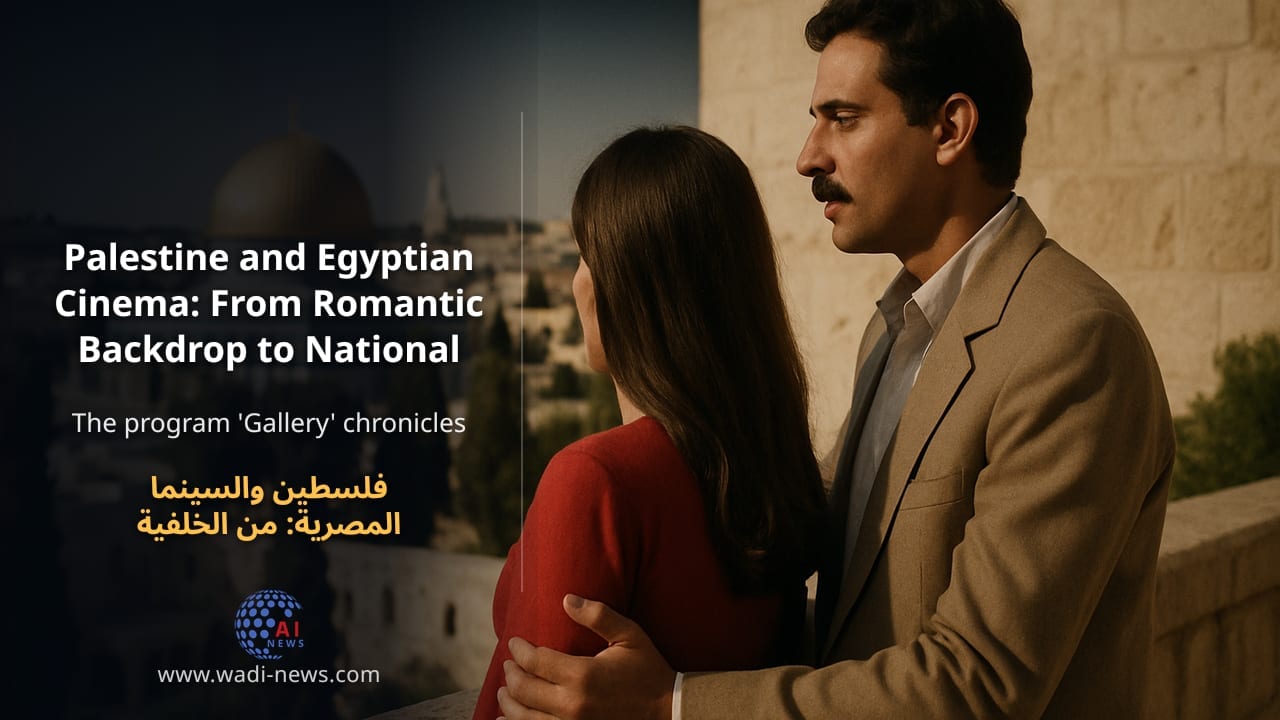
The program 'Gallery' explores the intricate relationship between Egyptian cinema and the Palestinian cause, tracing its evolution from a fleeting mention in the 1943 film 'The Straight Road' to the more recent series 'The Owners of the Land,' which reinstated the Palestinian individual as a true hero. This journey spans over eight decades, documenting how the portrayal of Palestine in cinema has shifted from romanticized narratives to a deeper engagement with the existential realities faced by Palestinians.
The episode aired on June 28, 2026, begins with a poignant scene from the film 'Naji al-Ali' (1992), where actor Mahmoud Jundi depicts a young Egyptian man losing his sanity amidst the devastation of the Israeli invasion of Lebanon in 1982. This moment encapsulates the absurdity of the situation, as the character sarcastically questions the absence of Arab armies. The scene transitions into a chaotic dance, set to the tune of 'A Hadeer Al-Bosta,' symbolizing a complete disconnection from the harsh realities of destruction, which some critics argue summarizes the trajectory of Egyptian drama as a whole.
The program highlights that the cinematic engagement with Palestine began even before the Nakba of 1948, specifically in 'The Straight Road,' directed by Egyptian-Jewish filmmaker Togo Mizrahi. In this film, a sign indicates that Palestine is only 114 kilometers away, subtly acknowledging its proximity as a neighboring state. However, following the Nakba, the cinematic narrative shifted dramatically, often simplifying the complex political landscape into romantic tales of Egyptian heroes rescuing beautiful Palestinian women, thereby avoiding the intricate realities of international politics.
With the rise of the Free Officers' Revolution in 1952, Egypt positioned itself at the forefront of the Arab nationalist project, making Palestine a central issue that mirrored the legitimacy of the new regime. The episode also reviews the film 'Land of Peace' (1957), where Omar Sharif plays a Palestinian freedom fighter, and Faten Hamama portrays a Palestinian girl aiding the fighters. This film attempts to break the prevailing narrative by showcasing resistance and the enemy, yet scholars argue that these films were more about Egypt than Palestine, with the Egyptian officer as the active hero and Palestine depicted as a passive character in need of rescue.
The episode further discusses the impact of the 1967 defeat, which shattered the invincible hero image that Egyptian cinema had built over 15 years. This defeat led to a crisis in the film industry regarding how to portray the Palestinian cause in light of Egypt's own struggles. In contrast to previous narratives, bolder films began to emerge, critiquing the regime itself, such as 'Chatter Above the Nile' and 'The Sparrow,' which delved into the roots of defeat. Although the Palestinian cause was sidelined during this period, it resurfaced in the 1972 film 'The Deceived' by director Tawfiq Saleh, b…