
ADVERTISEMENT
Tech
Aurangzeb's Akhbarat: The Empire That Ran on News Reports - And What They Reveal About Mughal India
Thousands of forgotten news reports are reshaping our understanding of Aurangzeb and the Mughal world, revealing the sophisticated information network that existed in Mughal India.
Jun 29, 2026 | 1-2 min read | By Wadi News Editorial Team
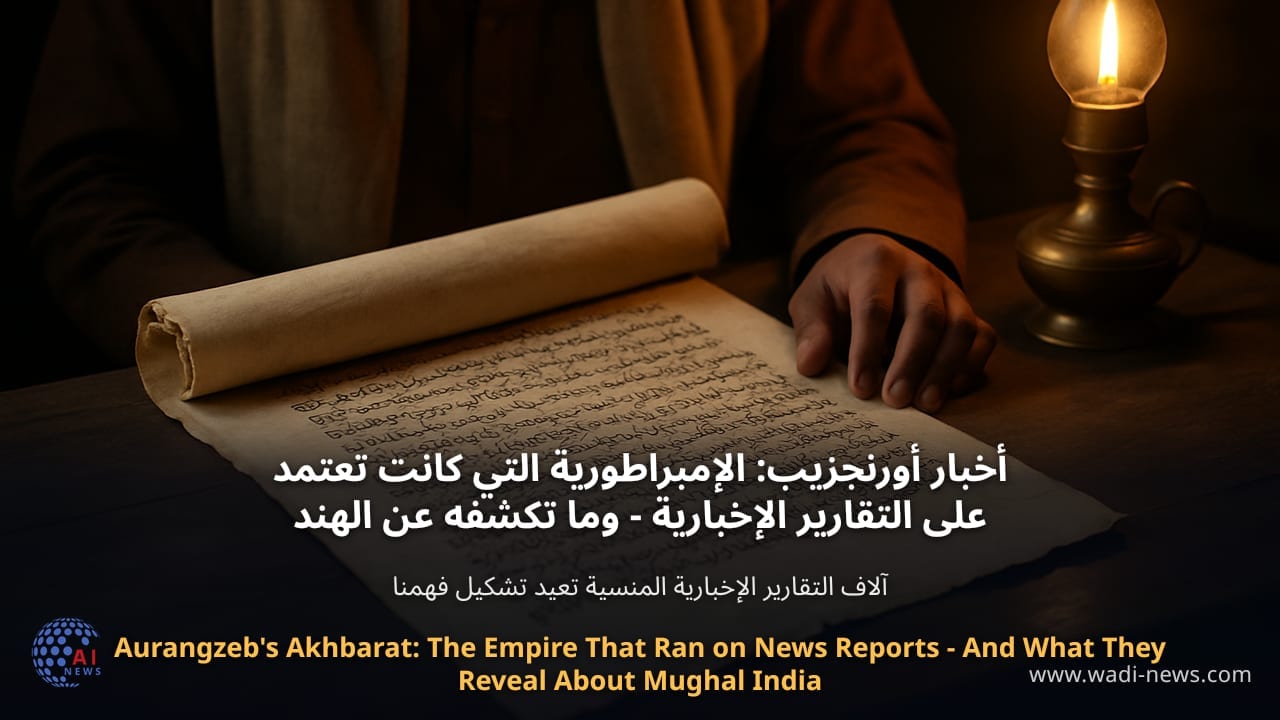
In the late 16th century, while Europe was busy inventing newspapers, Mughal India had already established its own intricate news network. This network was primarily composed of scribes, agents, and secretaries who compiled brief news reports known as akhbarat. These reports covered a wide range of topics, including court intrigues, military campaigns, appointments, financial matters, and even gossip. Written in Persian on fragile paper, these documents formed the backbone of the Mughal Empire's information dissemination system. They were not merely news bulletins; they served as intelligence briefs and official communications that connected the vast empire, which at its zenith governed much of the Indian subcontinent and a significant portion of the world's population.
Historians have long known about the existence of these reports, yet few have delved deeply into them. Munis D. Faruqui, a historian from the University of California, Berkeley, dedicated nearly two decades to studying these akhbarat. His research involved sifting through thousands of pages preserved in various archives across India and Britain, particularly focusing on the _Akhbarat-i Darbar-i Mualla_, a collection that provides insights into the reign of Aurangzeb, the last great expansionist emperor of the Mughal Empire. Faruqui's work has led to a fresh understanding of Aurangzeb, revealing not only his controversial nature but also the operational intricacies of one of history's most significant empires.
The akhbarat were circulated daily, often read aloud in gatherings of officials, thus ensuring that news from the imperial court reached even the most remote corners of the empire. The sheer volume of these reports provides a continuous record of the empire's activities, allowing historians to piece together a narrative of governance, societal dynamics, and political maneuvering during Aurangzeb's reign. Faruqui's findings challenge long-held assumptions about the Mughal court, particularly regarding the political influence of women and eunuchs, and the nature of Aurangzeb's rule. Contrary to popular belief, evidence of widespread religious conversions during his reign is scant, and the emperor's interactions with various religious communities were more nuanced than previously thought.
Faruqui's exploration of the akhbarat has also shed light on lesser-known figures, such as Zinat-un-Nisa, Aurangzeb's daughter, who emerges as a significant political player in her own right. Her repeated mentions in the reports indicate her influential role at court, prompting a reevaluation of the dynamics within the Mughal harem. This newfound understanding of Zinat-un-Nisa exemplifies how the akhbarat provide a more comprehensive view of the Mughal Empire, allowing historians to reassess not only Aurangzeb's legacy but also the broader historical narrative of the period.
Despite the challenges posed by the vast and unindexed nature of the akhbarat, Faruqui's meticulous research highlig…