
ADVERTISEMENT
Politics
The Burning Chessboard: A Game of Thrones in the Middle East Between Washington, Tehran, and Tel Aviv
The article compares the Middle East conflict to Game of Thrones, where the U.S., Iran, and Israel compete for power and influence. It argues that military action alone cannot end the conflict, and the region may face either a major political settlement or a long period of instability.
Arab World | May 14, 2026 | 1-2 min read | By Super Admin
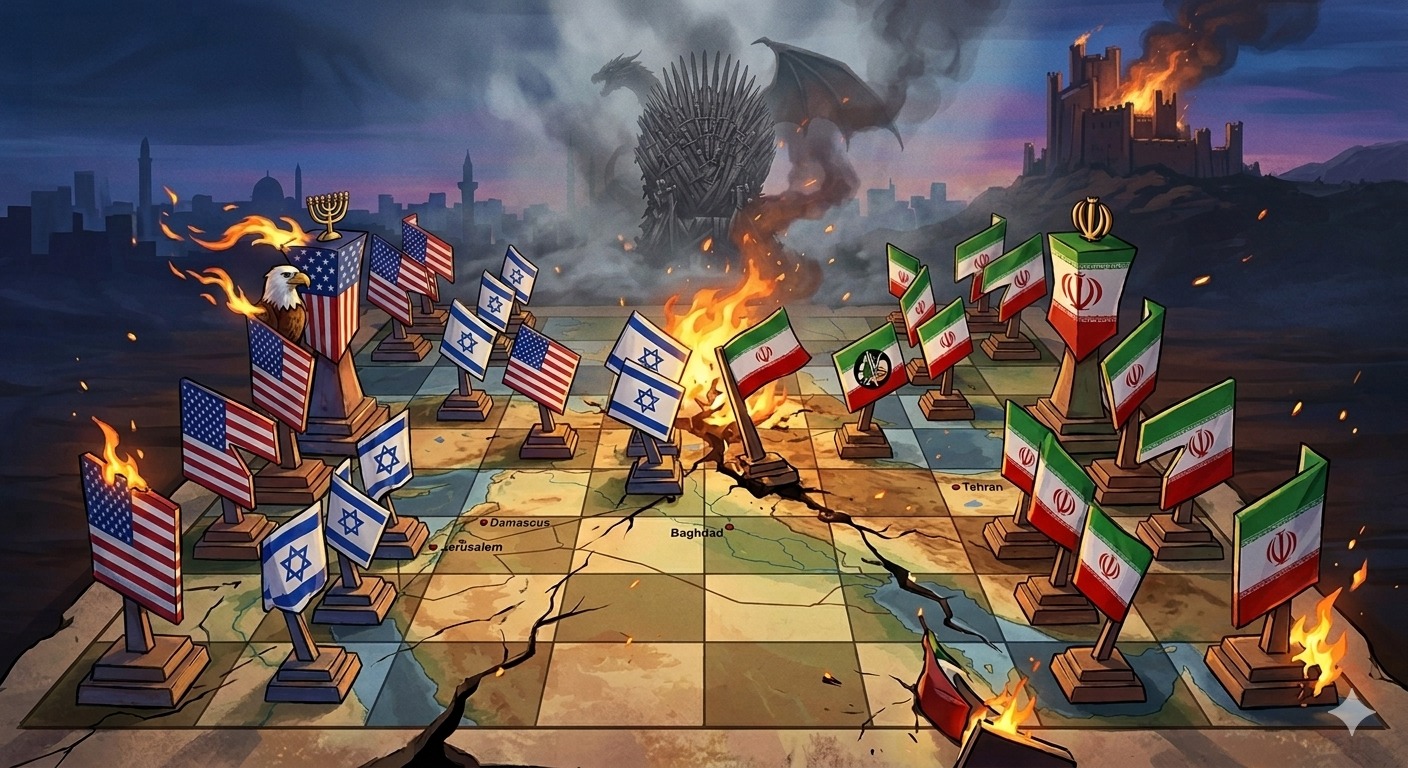
Scenes of destruction and continuous escalation in the Middle East dominate global headlines and international news agencies. The region has transformed into a bloody chessboard where regional and international powers struggle for influence and survival. Amid this complex landscape, the positions of the main actors — the United States, Israel, and Iran — form the core of a crisis that extends beyond geographical borders to touch the very foundation of the emerging global order.
If we attempt to decode the mysteries of this conflict, we may find no more fitting analytical framework than the dramatic saga Game of Thrones, where alliances intertwine, loyalties constantly shift, and the ultimate goal remains sitting on the “Iron Throne” of regional dominance.
In the fictional world of Westeros, noble families battle for absolute power, often ignoring the existential threat coming from the North. This mirrors today’s Middle East, which appears to be a real-life embodiment of that epic struggle. The United States, with its military fleets and economic influence, plays the role of the dominant power seeking to preserve the stability of the “Seven Kingdoms” — its allies in the region — and secure the flow of vital resources.
In contrast, Iran stands as an ambitious power determined to break this containment strategy, relying on a “proxy” approach that closely resembles the alliances of smaller houses in the series. Its influence stretches from Yemen to Lebanon, and from Iraq to Syria, in an attempt to encircle its rivals and expand its sphere of influence.
Israel, meanwhile, finds itself at the center of the storm, fortified behind advanced defensive systems much like the “Night’s Watch” behind the great Wall of ice. For Tel Aviv, the Iranian threat is not merely political; it is existential, requiring the mobilization of every possible alliance and capability.
This became particularly evident in the direct military confrontations witnessed recently, culminating in the Twelve-Day War of June 2025, during which both sides exchanged unprecedented strikes that shattered traditional rules of engagement.
What is striking about this conflict is the way principles intertwine with interests, much like in Game of Thrones, where there is no absolute black or white. History reminds us that the current hostility between Washington and Tehran was not always this severe. In fact, there were moments when interests converged, most notably during the “Iran-Contra” affair in the 1980s, when American and Israeli weapons were secretly transferred to Iran during its war with Iraq.
This stark contradiction confirms that international politics — like the schemes of King’s Landing — are governed by pure pragmatism, where even bitter enemies may cooperate in secret when necessity demands it.
Nevertheless, Iran’s greatest strategic mistake, resembling the errors of certain Westerosi leaders who alienated their neighbors, was expanding its circle of hostility to include much of the Arab world. Instead of building strong regional alliances, Tehran chose confrontation and the export of revolution, leaving itself strategically exposed and isolated in the face of the American-Israeli alliance.
This geopolitical isolation, combined with the economic exhaustion caused by sanctions and the costly nuclear program, places Tehran in a difficult position, where internal resources continue to erode while external commitments expand.
On the other hand, Washington and Tel Aviv face the dilemma of the Iranian “dragon” that cannot easily be tamed. Military strikes, no matter how precise, may delay the nuclear program or weaken proxy forces, but they cannot end the conflict. As the series itself demonstrated, brute force alone is insufficient to guarantee lasting stability.
Military solutions may create a temporary “cold peace,” but the embers remain alive beneath the ashes, ready to ignite with the slightest spark.
In the end, the pressing question remains: how will this epic conflict conclude? Will we witness a grand settlement that redraws the map of influence in the region, or are we heading toward a long winter of mutual exhaustion?
What is certain is that the Middle East, much like the world of Game of Thrones, does not believe in easy happy endings.