
ADVERTISEMENT
Tech
Room-temperature multiferroic could pave way to low-energy computing
Researchers at Rice University have developed a new multiferroic material that significantly outperforms its predecessor at room temperature, potentially revolutionizing low-energy computing.
Apr 29, 2026, 6:59 PM | 1-2 min read | By Wadi News Editorial Team
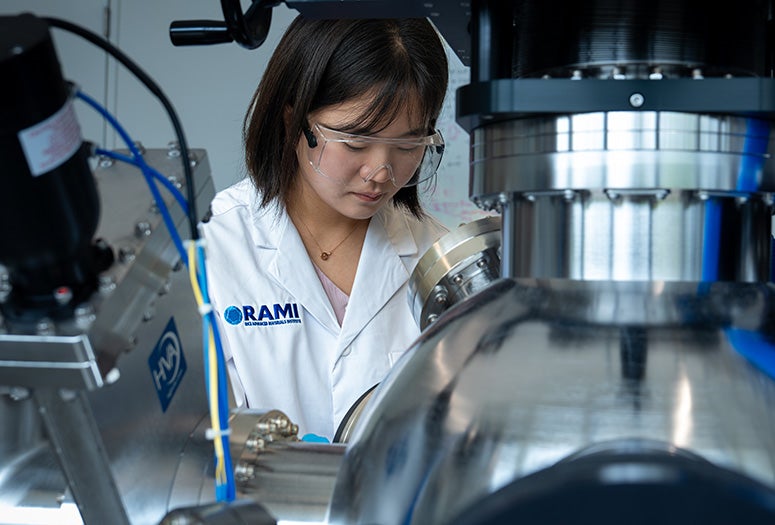
A team of researchers at Rice University has engineered a new version of a well-known multiferroic material that exhibits orders of magnitude higher performance at room temperature than its parent material. This groundbreaking study, published in the Proceedings of the National Academy of Sciences, reveals a modified version of bismuth ferrite that shows a tenfold increase in magnetization and a hundredfold increase in magnetoelectric coupling compared to standard varieties. The synthesis process involved mixing bismuth ferrite with barium titanate while simultaneously growing the material as a thin film on a substrate that distorts its crystal structure.
Lane Martin, a materials scientist at Rice and the study's lead author, emphasized the novelty of their approach, stating, "Nobody had ever dialed both knobs – the strain and the chemistry – at once." This innovative combination of two different material systems resulted in a new material with unique properties. The implications of this research are significant, as modern computing relies heavily on the manipulation of electron flow, a process that has reached an efficiency limit in silicon-based systems.
Martin pointed out the pressing energy challenges faced by electronics today, predicting that within the next five to ten years, computing could consume as much as a quarter to a third of all generated power, which is unsustainable. To address this issue, materials scientists are exploring new ways to utilize additional properties of electrons and other fundamental particles for computation. One promising avenue is the control of electron spin, a magnetic property that could lead to more efficient computing methods.
Multiferroics, as the name suggests, possess multiple order parameters, including ferroelectricity and magnetism. These materials are particularly interesting because of the coupling between their electric and magnetic properties, known as magnetoelectricity. This phenomenon allows for an electric field to influence a material's magnetism and vice versa, potentially enabling memory and logic operations with significantly reduced energy consumption. However, the challenge has been to find a single material that exhibits strong ferroelectric and magnetic properties at room temperature. Bismuth ferrite has been a candidate for years, but its magnetism has been limited due to the cancellation of atomic moments.
The addition of barium titanate, a nonmagnetic component, combined with carefully engineered strain, unexpectedly enhanced the new material's overall magnetization while maintaining strong electric properties. Tae Yeon Kim, a postdoctoral researcher and the first author of the study, expressed her surprise at the significant increase in magnetization, stating, "I did not expect such a large increase in magnetization." The research team conducted extensive validation of their findings, spending over six months making and testing samples to ensure reproducibility. This meticul…